
Childcare Frequently Asked Questions
-
All three Co Kids centres are licensed for children aged 3 months to 6 years. We are open from 7.30am to 6pm, Monday to Friday, and closed on weekends and public holidays.
-
Absolutely. Visits are welcomed and encouraged. Please use our enquiry form to tell us which centre you’re interested in, and our team will be in touch to arrange a time.Itchy I reply back to Alex's
-
You can receive an enrolment form during your visit or ask us to email one to you. To confirm your child’s place, the form must be completed in full and all required pages signed.
We will need to sight your child’s birth certificate or passport to verify their details and National Student Number. You will also need to provide two emergency contacts. A bond is payable at enrolment to secure your child’s place.
-
Availability varies by centre, your child’s age, and the days and hours of care you need. We recommend getting in touch as early as possible so we can discuss your family’s needs.
You are welcome to visit, meet the team and explore the centre before making a decision. If your preferred days are not immediately available, we can discuss alternatives or add your family to our waiting list.
-
We offer flexible options to suit different family needs, including 6.5-hour, 8-hour and full-day sessions. Available session options may vary by centre.
If your needs change after enrolment, we will do our best to accommodate a change to your child’s booked days or hours. Changes are subject to availability and should be discussed with your Centre Manager.
-
Fees vary by centre and depend on your child’s age and their booked days and hours. Your chosen centre can provide the current fee schedule and help you choose the option that best suits your family.
Fees include your child’s care and education during their booked hours, all meals and snacks, and the everyday learning experiences and resources included in the Co Kids programme. Fees also support our commitment to better-than-minimum teacher-to-child ratios, giving children more individual attention and meaningful interaction throughout the day.
Fees can be paid online. Family accounts must be kept two weeks in advance.
-
Several forms of financial support may help with the cost of early childhood education, depending on your family’s circumstances.
20 Hours ECE is available for eligible children aged 3, 4 and 5. It covers up to 20 hours of early childhood education each week, with a maximum of 6 hours per day. Co Kids participates in the scheme, and our team can explain how it applies to your child’s booked hours and fees.
WINZ Childcare Subsidy is income-tested support for eligible families. Applications are made through Work and Income, and the assistance you receive depends on your circumstances.
FamilyBoost is an Inland Revenue payment that lets eligible households claim back a portion of their early childhood education costs. Claims are made through myIR and eligibility depends on household income, childcare costs and other criteria.
Our team can provide the information needed for an application or claim, but eligibility is determined by the relevant government agency.
-
Yes. Fees remain payable when your child is sick, absent or away on holiday because their enrolled place and regular booked days are held for them.
Continuing fees during absences helps us keep fees as affordable as possible while maintaining experienced teaching teams, high-quality care and better-than-minimum teacher-to-child ratios.
-
Starting at a new early learning centre is a big step for children and families. We want you to feel comfortable and confident before your child’s first day.
We recommend three free settling visits. These give your child time to become familiar with the environment, meet their teachers and begin building relationships at their own pace. Every child is different, so we will work with you to shape the settling process around your child and family.
It is normal for some children to become upset at goodbye time. Our teachers offer reassurance, comfort and support, and you are welcome to contact the centre during the day to see how your child is getting on. If the transition is difficult, we will stay in close contact and agree on the best approach together.
-
Please bring a named bag, wet bag, water bottle and several changes of clothing suitable for the weather. Children have many opportunities for wet, messy and sensory play, so spare outfits are always useful.
Co Kids provides wipes, sunscreen, bedding, meals and snacks. If your child needs a particular sunscreen because of an allergy or sensitivity, you are welcome to provide a named alternative.
If your child has bottles, please bring their bottles and formula or expressed breast milk. Our teaching team will talk with you about their usual feeding routine. Your child may also bring a dummy, comforter or special item from home if it helps them feel safe and secure.
Please clearly name all bottles, clothing and personal belongings.
-
All meals and snacks are included. Our on-site chefs prepare fresh, nutritious food, with menus designed to give children a varied and balanced range of foods. Our menus are nut-free and contain no refined sugar, and we encourage relaxed, positive mealtimes.
We take allergies, intolerances and individual dietary needs seriously. We can cater for a range of medical, cultural, religious and family requirements, including vegetarian diets. Please provide clear, current information when your child enrols and whenever their needs change.
Young children can have strong food preferences or periods of selective eating. Our teachers and chefs support children without pressure while encouraging them to explore different tastes and textures. Please speak with us about any concerns or preferences so we can work together.
-
Every child has different sleep and rest needs. For younger children, our kaiako will talk with you about your child’s usual routine, sleep cues and preferences so we can provide as much consistency as possible between home and Co Kids.
Children sleep and rest in a safe, comfortable and supervised environment. Our team follows established safe-sleep practices and regularly checks sleeping children. We will keep you informed about when and how long your child slept.
-
Nappy changing is an important part of your child’s care and is approached with respect, warmth and individual attention. Our kaiako talk with children throughout the process, explain what is happening and encourage participation as children become more independent.
Nappies are checked regularly and changed as needed, following appropriate hygiene practices.
When your child is ready for toilet learning, we will work with you to provide a consistent, positive approach between home and Co Kids. Every child develops at their own pace, and we support them with patience, encouragement and no pressure.
-
The RIE/Pikler approach is based on respect, responsive relationships and trusting children as capable individuals. These principles guide the way our teachers interact with children, particularly during everyday care, play and learning.
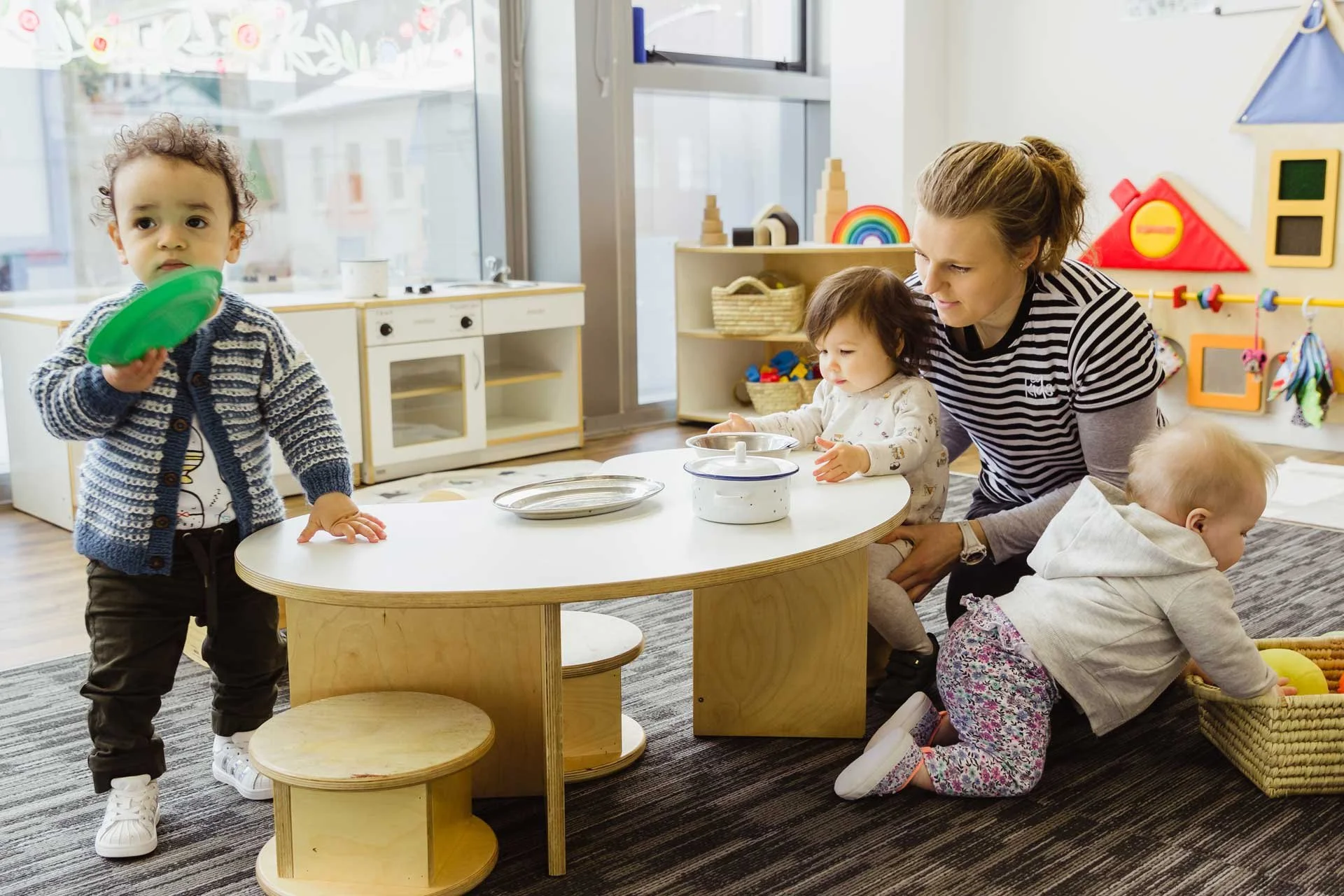
We slow down, listen and involve your child in what is happening. During routines such as nappy changing, feeding and dressing, teachers explain what they are doing and encourage children to participate. Children have time and space to move, play, explore and develop at their own pace, with teachers nearby to provide reassurance, encouragement and support.
For your child, this means being cared for in an environment where they are known, respected and listened to, with strong and secure relationships at the heart of their experience.
-
Children learn best when they are curious, engaged and actively involved. Through play, they develop communication, problem-solving, creativity, confidence, collaboration and perseverance.
Early literacy and numeracy are woven naturally through the day rather than taught as formal lessons. Children experience literacy through stories, conversations, songs, rhymes, mark-making, names, letters and sounds. Numeracy develops through counting, sorting, measuring, patterns, shapes, quantities and meaningful everyday uses of numbers.
Our teachers observe each child’s interests and development and use these to extend learning. This might mean adding measuring cups to water play, counting while preparing kai, making signs for a construction project or sharing books related to a current interest.
-
We help children develop the confidence, independence and skills needed for a positive transition to school. The programme builds foundations for learning through play, relationships and meaningful everyday experiences.
As children approach school age, kaiako provide opportunities to strengthen early literacy and numeracy, including recognising and writing their name, enjoying books and stories, developing awareness of letters and sounds, counting, recognising numbers and patterns, and solving problems.
We also support children to manage their belongings, follow routines and instructions, communicate their needs, take turns, work with others, build resilience and try new things. Our kaiako work in partnership with families and, where appropriate, schools to make the transition familiar and positive.
-
Yes. Children may take part in experiences within the local community, including walks, visits to parks or community spaces, and planned trips that extend their interests and learning.
Health and safety, supervision and teacher-to-child ratios are considered carefully for every excursion. Families receive information about planned outings and, where required, are asked for permission.
Most local excursions are included in our programme. If a special trip has an additional cost, families will always be told in advance.
-
We aim to maintain excellent teacher-to-child ratios during peak learning times:
Under 1 year: 1 teacher to 3 children
1-year-olds: 1 teacher to 4 children
2-year-olds: 1 teacher to 6 children
3–5-year-olds: 1 teacher to 8 children
We also aim to have at least 80% qualified teachers across our teaching teams. Alongside our qualified kaiako, we may have teachers studying towards an early childhood teaching qualification and other experienced educators who contribute to our centre community.
Actual staffing is planned around the number and ages of children attending throughout the day, and we meet Ministry of Education requirements at all times.
-
We use Storypark to keep you connected with your child’s experiences, learning and development.
Each child has an individual learning plan developed in partnership with their family and informed by the aspirations you share. Our kaiako combine these aspirations with observations of your child’s interests, strengths and development to guide intentional teaching and learning opportunities.
Through Storypark, you receive learning notes, photos and updates showing what your child has been doing and the learning taking place. You can comment and contribute, helping us build a shared picture of your child’s learning between home and Co Kids.
We also value everyday conversations at drop-off and pick-up. You are always welcome to speak with your child’s kaiako.
-
Your child’s health, safety and wellbeing are a priority. If your child becomes unwell, we will care for and comfort them and contact you if they need to be collected. If they are injured, our team will provide appropriate first aid, record the incident and tell you what happened. For a serious illness or injury, we will seek emergency medical assistance and contact you as soon as possible.
Medication must be supplied in its original packaging with clear instructions. A parent or caregiver must complete the appropriate authorisation before our team can administer it, and all medication given is documented.
If your child has an ongoing medical condition, allergy or other health need, please discuss it with us before they start or as soon as you become aware of it. We will work with you to ensure we have current information, medication and, where required, an individual health or management plan.
-
Every child is unique and develops at their own pace. Our kaiako build warm, trusting relationships so children feel safe, secure, valued and understood.
We use positive guidance to help children understand their emotions, communicate their needs, develop self-regulation and learn positive ways to interact with others. We consider what a behaviour may be communicating and how we can best support the child.
If your child may benefit from additional learning, behavioural or developmental support, we will talk with you and work together to understand their strengths and needs. With your involvement and consent, we can develop individual strategies and work with external specialists or support services where appropriate.
-
Each centre has a leadership team that supports children, families and teaching teams and oversees the smooth day-to-day running of the centre.
Your child’s kaiako or Team Leader is usually the first person to speak with about your child’s day, learning, routines or experiences. The Centre Manager oversees the wider operation and can help with enrolment, staffing, centre operations, questions or concerns that need further discussion.
Our Centre Managers are supported by the National Centre Director and governance team, providing consistency, oversight and support across all three centres.
We encourage families to talk with us at any time. If you are unsure who to approach, ask any team member and we will connect you with the right person.